
The support industry has spent decades getting faster. It hasn't spent nearly enough time getting better at being human, and those two things are not the same project.
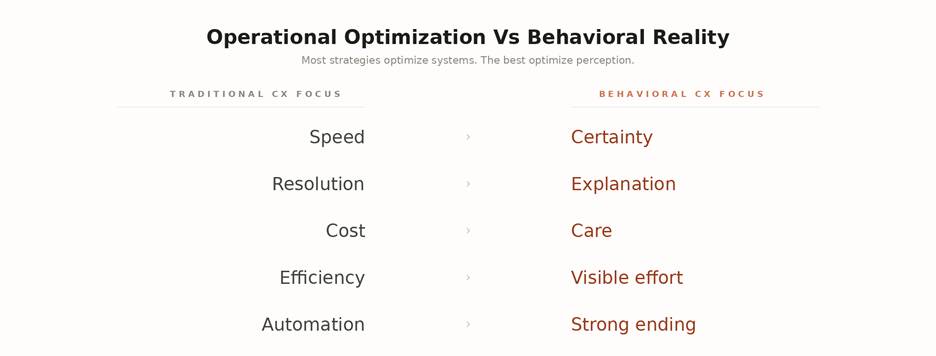
Most CX strategy is built on the assumption that customers are rational actors weighing inputs and outputs: speed against cost, effort against value, outcome against expectation. Get the formula right and satisfaction follows. It's a tidy theory, and it's wrong often enough that it should bother us more than it does. Customers regularly forgive slow. They even forgive expensive. They rarely forgive feeling forgotten.
The variable most CX programs underweight isn't operational at all; it's psychological. Once you start looking at experience through that lens, a lot of what we've been optimizing starts to look like the wrong target entirely.
Here are five realities that psychology understands about how people experience service that most CX strategies still don't.
Certainty Builds Trust Faster Than Speed Does
Ask most contact centers what their customers want and the answer comes back instantly: speed. Shorter hold times, faster resolutions, fewer steps. Speed matters, but it's not actually doing the emotional lifting. What customers are really asking for is certainty, a signal that the process is moving, that someone is accountable for it, that the outcome is knowable even if it isn't immediate.
This is why a customer who is told "this will take 15 minutes" tends to feel better about a longer wait than a customer who is told nothing but waits five. The ambiguity is the cost, not the delay.
Uncertainty forces the brain to keep generating scenarios to fill the gap, and most of those scenarios are worse than the truth. A clear timeline, even an unwelcome one, closes that loop. This is also why "your case has been escalated" lands so much better than silence, even when escalation doesn't speed anything up. It converts an unknown into a known, and certainty is where trust lives.
Unexplained Waiting Feels Longer Than The Actual Wait
This is a close cousin of the point above, but worth separating out because it's so consistently mismeasured. Companies track wait time religiously and rarely track explained time, even though the two produce wildly different emotional outcomes for an identical number of minutes. A wait with a visible reason: "we're verifying your account," "high volume due to the outage" gets processed by the brain as effort being applied on the customer's behalf. The same wait with no explanation gets processed as neglect.
The fix isn't complicated, but it requires a mindset shift: silence should be reserved for when nothing is wrong, not deployed when everything feels uncertain.
Contact centers default to quiet during their slowest, most strained moments, exactly when customers most need to hear that someone is still there. An explanation isn't just courtesy. It's the difference between a customer who waits and a customer who wonders.
Customers Forgive Mistakes. They Don't Forgive Indifference.
Service recovery research has shown this for years, and it still doesn’t seem to have fully landed in how companies build processes: a mistake, handled with visible care, often produces more loyalty than flawless service that comes with zero personality. This isn’t customers being irrational or forgiving for sport.
It’s that a mistake plus a genuine response gives them something speed never can: evidence that a human being on the other end actually cared what happened to them.
I’ve seen this play out firsthand. When a subscription product drop went out with an incorrect listing, the instinct might have been to quietly fix it and move on. Instead, we cancelled the affected orders, created replacements, and sent a proactive email to every impacted customer before they had a chance to notice or write in to support first. We were direct about what had happened and what we were doing about it.
The result wasn’t the damage control we’d braced for; it was the opposite. Subscription cancellations didn’t spike. Customer loyalty did. Not because the error hadn’t happened, but because of what the response said about how much we valued the relationship.
What customers can’t forgive is indifference, because indifference doesn’t read as a bad outcome.
It reads as a verdict: you didn’t matter enough for someone to bother. That’s a much deeper wound than a product error, and it’s the one most “efficient” service models are quietly inflicting at scale every time they optimize a human moment down into a script, a bot loop, or a closed feedback channel.
Perceived Effort Matters More Than Actual Effort
People don't always just want their problems solved. They want to feel informed of the steps taken, that solving it required actionable effort. This sounds counterintuitive in an industry obsessed with reducing friction, but it explains a lot of otherwise strange customer behavior, like skepticism toward instant refunds or distrust of a problem that resolves "too easily."
The implication isn't that companies should manufacture friction. That would be its own kind of indifference, just dressed up as effort.
It's that the effort already being spent, often considerable, needs to be made visible rather than hidden behind seamless design. "I checked with our fulfillment team and confirmed this myself" does more for trust than the same outcome delivered with no narration at all.
Invisible effort doesn't register as effort. It just registers as luck, and luck doesn't build loyalty.
People Remember Endings, Not Averages
This is the one with the deepest research behind it, and the one our measurements are the worst at capturing. Memory doesn’t average an experience; it encodes the peak moment and the ending, and largely discards everything else. Behavioral psychologists call this the Peak-End Rule, a finding associated with Daniel Kahneman that has held up across decades of replication in an uncomfortable range of contexts.
A mediocre interaction with a warm, competent close out will be remembered more fondly than a smooth interaction that fizzles out on an unresolved or transactional note.
Most metrics measure the whole journey as if every touchpoint counts equally. Customers don’t experience it that way, though, and they certainly don’t remember it that way. The practical implication is uncomfortable for anyone trying to scale service efficiently: the last thirty seconds of an interaction may matter more than the preceding ten minutes combined. This means the moment most likely to get rushed, the close-out once the 'real' problem is solved, is the moment that should be protected.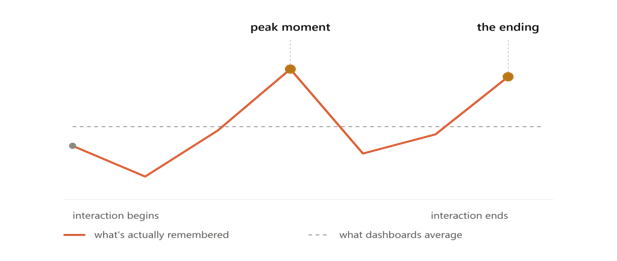
*illustrative, not measured data
The Pattern Underneath the Pattern
None of these five principles are really about service mechanics. They’re about something we all know innately but forget to center the experience around: making sure customers feel that they matter.
That desire hasn’t changed even as the channels we deliver it through have multiplied and automated. Every one of these principles points the same direction: that experience isn't just an efficiency engine. It’s a relationship that’s constantly, instinctively checking for evidence of care.
Companies that build for the metrics will keep being surprised when satisfied-on-paper customers leave anyway. Companies that build for the psychology will understand something their dashboards can’t show them: customers were never just measuring outcomes. They were measuring whether anyone was paying attention enough to care.
Author Bio
Beth Reedy, Manager of Integrated Systems & Customer Solutions, Black Rifle Coffee Company
Beth is a Customer Experience and Operations leader at Black Rifle Coffee Company, with over 5 years in CX and a degree in psychology, focused on scaling human-centered solutions at the enterprise level. Her work has driven measurable business outcomes, including over a quarter of a million in direct revenue impact and tens of thousands of customer interactions enabled through self-service and retention-focused initiatives. Known for turning complexity into clarity, Beth blends data, technology, and cross-functional collaboration to build scalable CX solutions spanning chatbot development, system design, platform optimization, and leadership grounded in empathy and long-term impact.
Reimagine Collaboration and Communications with Enterprise Connect
All In on What’s Next
For over 35 years, Enterprise Connect has been the premier event where IT leaders, solution providers, and industry analysts come together to define the future of enterprise communications. As the most trusted conference in the industry, we deliver cutting-edge insights, world-class networking opportunities, and hands-on solutions that drive real business success.
Enterprise Connect is more than an event—it’s an experience that empowers enterprise communications leaders to reimagine the future of work. With elevated content, curated networking, and an engaging atmosphere, it remains the must-attend conference for professionals shaping the industry’s evolution.
Our mission is to equip you with the tools, strategies, and actionable insights needed to address your organization’s unique challenges. With industry transformation in mind, this year’s program introduces fresh new conference tracks, including:
- Legacy Unleashed: Optimizing Your Communications Backbone
- Workplace Reimagined: Engineering Tomorrow's Collaboration
- Tech Disruption Zone: Implementing Without Imploding
- Achieving Transformation: Architecting Your 3-5 Year Roadmap
- Future Shock: Communications Tech Beyond the Horizon
Featuring the most comprehensive program of objective content and an expansive vendor-neutral expo hall, Enterprise Connect is your ultimate resource for advancing collaboration, CX, and AV strategies. Join us to stay ahead, connect with industry trailblazers, and lead the transformation of enterprise communications.